
Klaviyo vs Mailchimp for Ecommerce: Our Verdict (2026)
If you run an online store, the email platform you choose isn't just a line item on your SaaS budget — it's a revenue lever. Klaviyo and Mailchimp are the two names that come up in almost every ecommerce conversation, and for good reason. But they're built for fundamentally different operators, and picking the wrong one will cost you either money or capability.
Here's the short answer: Klaviyo wins for serious ecommerce stores; Mailchimp wins for simplicity and budget at smaller scale. The longer answer involves your revenue, your team's technical comfort, and how deeply you want to leverage customer data. Let's get into it.
Platform Overview: What Each Tool Is Actually Built For
Klaviyo: Ecommerce DNA From the Ground Up
Klaviyo wasn't retrofitted for ecommerce — it was built exclusively for it. The platform powers roughly 176,000 brands worldwide and has spent over a decade solving the specific problems online stores face: abandoned carts, browse abandonment, post-purchase sequences, and predictive lifetime value modeling. Every feature traces back to a commercial outcome.
What makes this matter in practice: Klaviyo automatically tracks customer browsing behavior, cart additions, purchase patterns, and predicted lifetime value without requiring custom dev work. Abandoned browse campaigns and dynamic product recommendations aren't bolt-on additions — they're core functionality. The platform syncs with Shopify in real time, meaning a customer who completes a purchase gets pulled out of an abandoned cart flow immediately, not on the next sync cycle.
Mailchimp: The Generalist That Added Ecommerce Later
Mailchimp launched in 2001 as a general-purpose email tool. It added ecommerce features over time, and they're genuinely capable — but the generalist origin shows. The platform serves nonprofits, professional services, bloggers, and small businesses just as readily as it serves Shopify stores. That breadth makes Mailchimp more accessible, but it also means ecommerce-specific functionality is less deeply integrated.
That's not automatically a disqualifier. If you're running a lean operation and need clean templates, basic automations, and a low barrier to getting started, Mailchimp's generalist approach is a feature, not a bug. The interface is intuitive, the editor is clean, and you won't need a dedicated email specialist to get campaigns out the door.
Pricing: What You'll Actually Pay
Both platforms offer free tiers, but the structure of their paid plans diverges in ways that significantly affect total cost as you scale. One critical difference: Klaviyo counts each customer profile once, even if they appear on multiple lists. Mailchimp counts a contact once per audience — so one person on three lists counts as three contacts. That billing quirk alone can dramatically inflate Mailchimp costs for stores with segmented audiences.
| Tier | Klaviyo | Mailchimp |
|---|---|---|
| Free Plan | 250 contacts, 500 emails/month | 500 contacts, 1,000 emails/month |
| 500 contacts | ~$20/month | Essentials starts ~$13/month (limited features) |
| 1,000 contacts | ~$30/month | ~$20–26/month (Essentials, feature-restricted) |
| 10,000 contacts | ~$150/month | ~$100–135/month (Standard tier) |
| 50,000 contacts | $850+/month | $350+/month (but many advanced features still gated) |
| Free support duration | 60 days | 30 days |
At smaller list sizes, Mailchimp's sticker price looks lower. But the comparison gets murkier when you account for what's actually included. On Klaviyo's free plan, all email features are unlocked — your only constraint is send volume. On Mailchimp, core features like advanced segmentation, A/B testing, and custom templates are locked behind higher-tier paid plans. You can find yourself on a Standard or Premium plan not because of list size, but because you need features that should be table stakes.
Newsletter
Get the latest SaaS reviews in your inbox
By subscribing, you agree to receive email updates. Unsubscribe any time. Privacy policy.
The practical conclusion: Mailchimp is cheaper at small scale if you can live with its feature restrictions. Klaviyo's pricing looks higher on paper but often delivers more actual capability per dollar, especially once you're past the 5,000–10,000 contact range and need serious segmentation.
Ecommerce Features: Where Klaviyo Pulls Ahead
Segmentation and Predictive Analytics
This is Klaviyo's strongest competitive moat. The platform builds dynamic customer segments automatically based on real-time behavioral data — not just what subscribers clicked in an email, but what they browsed on your site, what they added to cart, how long since their last purchase, and their predicted lifetime value. You can build a segment of "customers with a predicted LTV over $500 who haven't purchased in 90 days" without writing a single line of code.
Mailchimp's segmentation is functional but more static. You can filter by purchase history, engagement, and demographics, but the predictive layer and real-time behavioral triggers that Klaviyo bakes in aren't present at the same depth. For stores running sophisticated lifecycle marketing — win-back campaigns, VIP tiers, churn prediction — the gap is significant.
Automation Flows
Both platforms support core ecommerce automations: welcome series, abandoned cart, post-purchase follow-up, and browse abandonment. Klaviyo's abandoned browse flow, in particular, is more granular — it can trigger based on specific product category views, not just cart events.
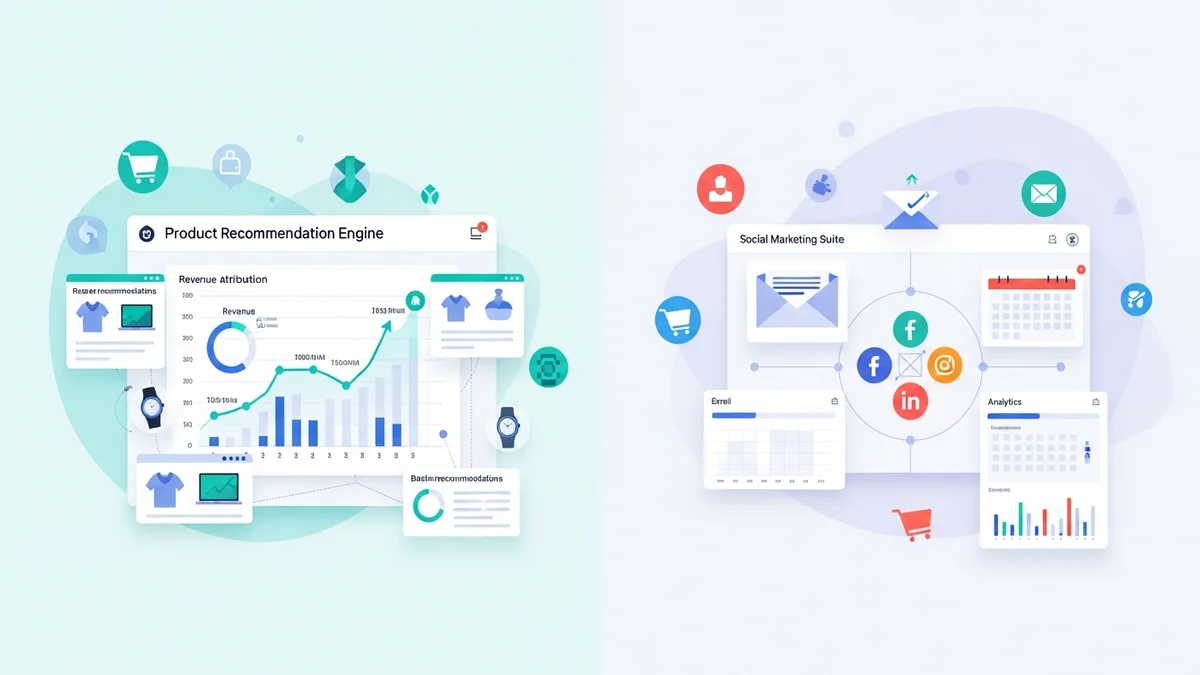
Klaviyo also supports revenue attribution directly within the platform. You can see exactly how much revenue each flow generated, which makes optimization straightforward. Mailchimp offers basic campaign reporting but revenue attribution requires deeper integration with your analytics stack.
Shopify Integration Depth
Klaviyo's Shopify integration syncs in real time. When a customer completes a purchase, the data updates immediately — suppressing abandoned cart emails on the spot, updating customer profiles, and triggering post-purchase sequences without delay. Mailchimp's Shopify integration works, but sync timing is less immediate, which can create gaps in automation accuracy.
Free Plan Comparison: Klaviyo's Hidden Advantage
The free plan comparison deserves its own section because it's genuinely counterintuitive. Mailchimp offers a more generous free tier on paper — 500 contacts and 1,000 monthly sends vs. Klaviyo's 250 contacts and 500 sends. But Klaviyo's free plan unlocks the full feature set, while Mailchimp's free plan is deliberately restrictive.
On Mailchimp's free plan, advanced segmentation, A/B testing, and several automation types are unavailable. You're essentially getting a stripped-down tool to test the interface. On Klaviyo's free plan, you can build the same predictive segments, run the same automation flows, and access the same analytics as a paying customer — you're just limited by volume.
For early-stage stores that want to build sophisticated email infrastructure before they hit the contact thresholds, this is a meaningful advantage. You can architect your full automation stack on Klaviyo's free tier and scale into the paid plan without rebuilding anything.
Both platforms cut off live support after the free trial period — Mailchimp after 30 days, Klaviyo after 60. After that, paid plans are required for email or chat support access. Neither is generous here, but Klaviyo gives you twice the onboarding runway.
Contact Management: The Double-Count Problem
Mailchimp's contact counting methodology is worth flagging explicitly. If your store maintains separate audiences — say, one for retail customers and one for wholesale — a contact who appears in both gets counted twice toward your billing threshold. This isn't a hypothetical edge case: any store running multiple audience segments faces this.
Klaviyo counts each unique profile once, regardless of how many lists or segments they appear in. As audience complexity grows, this difference compounds. A store with 10,000 real customers spread across five overlapping segments could find its Mailchimp contact count inflated well beyond the actual list size — pushing it into a higher billing tier for no operational reason.
This is a structural disadvantage in Mailchimp's pricing model that becomes more painful as your segmentation sophistication increases. Ironically, the more you use the platform, the more it costs relative to Klaviyo.
Who Should Choose Klaviyo vs Mailchimp
Choose Klaviyo If:
- Your monthly revenue exceeds $50,000 and email is a significant revenue channel
- You need real-time behavioral segmentation and predictive analytics
- You run multiple overlapping customer segments that would inflate Mailchimp's contact count
- You want revenue attribution built directly into your email reporting
- Your team is comfortable with a steeper initial learning curve in exchange for more capability
Choose Mailchimp If:
- Your monthly revenue is under $20,000 and you're primarily sending newsletters and basic promotions
- You need a single platform that handles non-ecommerce email use cases alongside your store
- Ease of use matters more than segmentation depth
- You want native integrations with tools like Canva, Vimeo, and Google Analytics without additional setup
It's also worth acknowledging that neither platform may be the right tool for outbound prospecting or cold email. If your goal is high-volume cold outreach, you'd be better served by tools like Smartlead or Lemlist, which are purpose-built for that workflow. Klaviyo and Mailchimp are retention and lifecycle tools — they operate on opted-in lists, not cold prospecting databases.
Similarly, if AI-generated email copy is a priority, pairing either platform with Copy.ai will give you better content output than relying on either tool's built-in AI writing features alone. The copy layer and the sending layer are separate problems worth solving separately.
For stores considering alternatives altogether, ActiveCampaign occupies an interesting middle ground — it has stronger automation capabilities than Mailchimp and a lower price ceiling than Klaviyo at mid-scale, though it lacks Klaviyo's ecommerce-native depth.
Final Verdict
The Klaviyo vs Mailchimp decision for ecommerce ultimately comes down to where you are in your growth curve and how seriously you're treating email as a revenue channel.
Mailchimp is a legitimate starting point. The interface is clean, the learning curve is shallow, and for stores sending straightforward campaigns to modest lists, it does the job. The pricing advantage at small scale is real — but it erodes as you need more features and more segments, and Mailchimp's contact double-counting is a structural flaw that punishes sophisticated users.
Klaviyo is the right tool once email becomes a serious revenue lever. The ecommerce-specific features — real-time Shopify sync, predictive analytics, behavioral segmentation, and built-in revenue attribution — aren't nice-to-haves for a $100k/month store. They're the difference between email that pays for itself ten times over and email that's just a cost center. The fact that Klaviyo's free plan unlocks the full feature set is a genuine competitive advantage for stores that want to build properly from day one.
If you're launching, Mailchimp is defensible. If you're scaling, Klaviyo is the platform to grow into. And if you've already outgrown both, that's a conversation worth having with your whole marketing stack, not just your email tool.