
Why Your Follow-Up Strategy Is Costing You Deals
Here's an uncomfortable truth for anyone running outbound sales or lead nurturing: 80% of sales happen after 5 to 12 follow-ups, yet most teams give up after one or two. The gap between what your pipeline needs and what your reps can realistically execute by hand is where revenue goes to die.
Manual follow-ups are broken in a specific, predictable way. Reps copy-paste templates, swap in a first name, and call it personalization. The actual follow-up from yesterday's demo call? It's sitting in someone's head, not in the prospect's inbox. Meanwhile, response time—one of the highest-leverage variables in sales—degrades from minutes to hours to days.
AI-powered email follow-up automation fixes this, but not in the way most vendors advertise. This guide covers what actually works, where the real leverage is, and which tools are worth your time in 2026.
What AI Email Follow-Up Automation Actually Does
The phrase "email automation" gets stretched to cover everything from basic drip sequences to sophisticated AI agents that respond to prospect behavior in real time. These are fundamentally different things, and conflating them leads to buying the wrong tool for the wrong problem.
Tier 1: Scheduled Sequences
The baseline. You write emails in advance, set delays, and the tool sends them at preset intervals regardless of what the prospect does. Tools like Instantly and Smartlead operate at this tier, with volume and deliverability as their primary differentiator. Useful for cold outreach at scale, but not truly intelligent—it's automation, not AI.
Tier 2: Behavior-Triggered Sequences
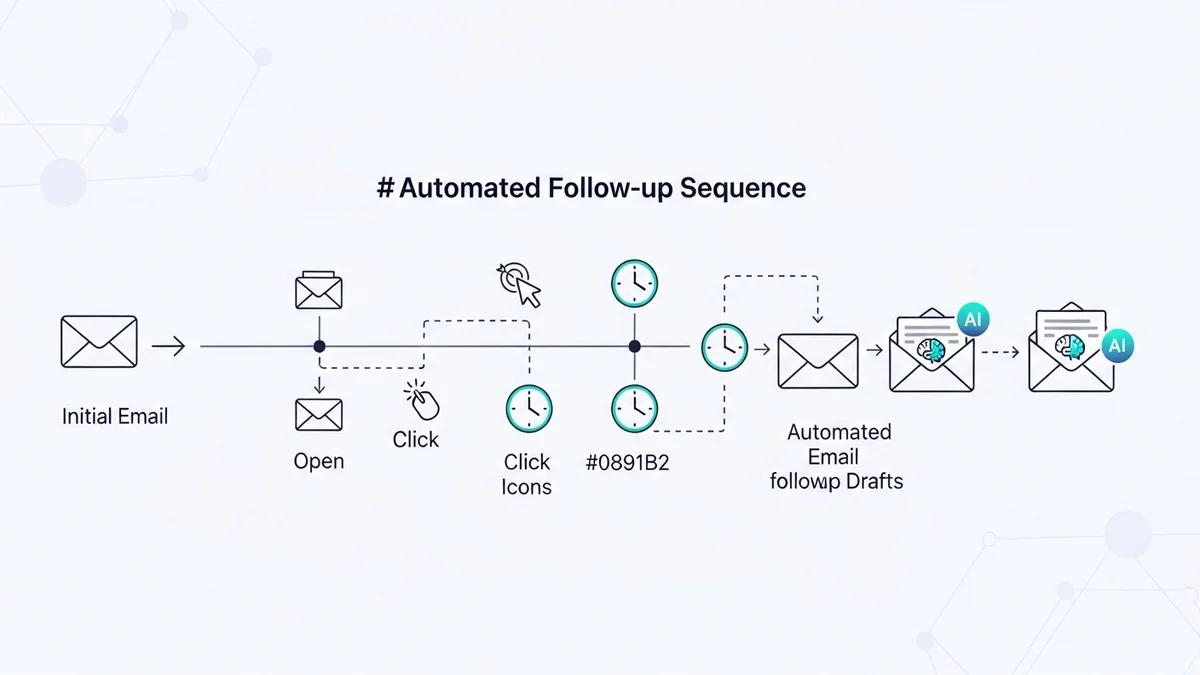
The system watches for opens, clicks, replies, and link visits, then routes prospects into different branches based on what they do. Opened but didn't reply? Send email variant B. Clicked the pricing page? Trigger a high-priority task for the rep. ActiveCampaign has built serious depth here, particularly for B2C and e-commerce contexts. This is where personalization starts to feel less hollow.
Tier 3: Context-Aware AI Drafting
The current frontier. AI reads your call transcripts, CRM history, and previous email threads, then drafts a follow-up that references what was actually discussed—not just the prospect's name. Reps who follow up within one hour of a call see 40% higher reply rates, and AI-assisted drafting is what makes that timeline achievable at scale. Personalized campaigns generated this way consistently see roughly double the reply rates compared to generic template blasts.
The Five Workflows Worth Automating Right Now
Not everything should be automated. Automating a bad process just creates bad output faster. But these five workflows have clear mechanical steps that AI handles better than humans—not because humans couldn't do them, but because humans won't do them consistently.
1. Post-Call Follow-Ups
This is the highest-value automation available to sales teams right now. The window between ending a call and the prospect's attention moving elsewhere is measured in hours, not days. AI that pulls from call notes and CRM data to draft a contextual recap email—with next steps, the specific pain points discussed, and a clear call to action—can be sent for review in minutes. The rep reads it, makes two edits, and hits send. Done.
2. Multi-Touch Outreach Sequences
Research consistently shows that sequences of 4 to 7 emails outperform shorter ones, yet most reps abandon follow-up after the first or second attempt. Automated sequences enforce the cadence that works, not the one that feels comfortable. The key is building sequences that escalate in specificity—early emails establish context, later emails reference the earlier ones, and the final email is a clean break that respects the prospect's time.
3. Re-Engagement Campaigns
Prospects who went cold three months ago aren't necessarily lost. They may have had a budget freeze, a reorganization, or a competing priority. AI can monitor your CRM for deals that stalled, surface them at appropriate intervals, and draft re-engagement emails that reference the original conversation. Lemlist handles this type of conditional branching particularly well, with variable logic that adapts messaging based on how long the deal has been dormant.
Newsletter
Get the latest SaaS reviews in your inbox
By subscribing, you agree to receive email updates. Unsubscribe any time. Privacy policy.
4. CRM Data Entry and Logging
Sales reps spend an estimated 5 to 6 hours per week on manual CRM data entry. That's a quarter of a standard workday, every week, going to administrative overhead instead of selling. Modern automation pushes call summaries, next steps, and deal stage updates directly to your CRM after every interaction. This isn't glamorous, but eliminating it is one of the fastest ways to give a sales team more selling time without adding headcount.
5. Meeting Booking and Reminder Sequences
The gap between "I'm interested" and a scheduled meeting is where a surprising number of deals evaporate. Automated booking links, confirmation emails, and pre-meeting reminders reduce no-show rates and eliminate the back-and-forth that burns rep time. Tools like Superhuman streamline the inbox-side of this workflow, while dedicated scheduling tools handle the calendar logic.
Tool Comparison: Which Platforms Deliver on AI Follow-Up
The market is overcrowded with tools that use "AI" as a marketing term for what is really just conditional logic with a chatbot wrapper. The table below reflects meaningful distinctions based on what these tools actually do in production, not their feature marketing pages.
| Tool | Primary Use Case | AI Depth | Best For | Sequence Length Support |
|---|---|---|---|---|
| Instantly | Cold outbound at scale | Template generation, A/B testing | High-volume SDR teams | Unlimited steps |
| Smartlead | Multi-mailbox outbound | Deliverability AI, reply detection | Agencies managing multiple clients | Up to 26 steps |
| ActiveCampaign | Behavior-triggered nurturing | Predictive sending, lead scoring | B2C and e-commerce follow-up | Unlimited with branching logic |
| Lemlist | Personalized outbound sequences | Dynamic variables, condition branching | SMB sales teams with video outreach | Up to 30 steps |
| Mailchimp | Email marketing automation | Send-time optimization, content suggestions | Newsletter and marketing follow-up | Limited branching |
The honest takeaway: no single tool wins across every use case. Cold outbound teams will find Instantly or Smartlead more purpose-built for their volume needs. Teams running marketing-driven nurture campaigns will get more leverage from ActiveCampaign's behavioral triggers. The mistake is buying a high-volume cold outreach tool for a marketing nurture workflow, or vice versa.
What Not to Automate (And Why It Matters)
The failure mode of email automation isn't that it doesn't work—it's that it works too well at sending the wrong things. A poorly configured sequence can damage a prospect relationship faster than no follow-up at all.
Negotiations and Late-Stage Deals
Once a deal is in active negotiation, automated sequences should stop. The prospect is talking to your rep; they don't need a canned "just checking in" email arriving in parallel. Segment your sequences carefully so late-stage deals are excluded from active drips.
Replies That Need Human Judgment
When a prospect replies with an objection, a question about pricing, or a request for a custom proposal, the automation should stop and a human should take over. Most modern tools detect replies and pause the sequence automatically—verify that this is working in your setup before going live.
Relationship Maintenance With Existing Customers
Automated re-engagement emails to customers who've been with you for two years will feel exactly like what they are: a form letter. Customer success and account expansion require a human touch that AI can assist with (drafting, summarizing history) but shouldn't fully replace.
How to Implement AI Follow-Up Automation Without Losing the Human Element
The teams that get this wrong treat automation as a replacement for human judgment. The teams that get it right use automation to protect human judgment—by handling the mechanical work so reps can focus on the conversations that actually require skill.
Start With Your Worst Bottleneck
Audit where follow-ups are actually breaking down. If post-call emails are going out 24 hours late, solve that first. If your cold outreach sequences stop at email two, extend them and test. Don't try to automate everything simultaneously—you'll create chaos and lose the ability to diagnose what's working.
Build Sequences That Escalate Naturally
The research benchmark of 4 to 7 emails isn't arbitrary—it reflects the number of touches most prospects need before they're ready to engage. Your sequence should tell a story: establish relevance, introduce proof, address the most common objection, create urgency, and offer an exit. Each email should reference the last, not restart the conversation from scratch.
Review AI Drafts Before They Send
For high-value prospects, don't let AI emails send without a rep review. The efficiency gain from AI drafting is still enormous even when a human approves every email—you're reducing writing time from 10 minutes to 90 seconds, not removing the human from the loop entirely. For high-volume cold outreach, fully automated sending at scale makes sense. For mid-market and enterprise accounts, keep a human in the final step.
Measure Reply Rates, Not Open Rates
Open rates are increasingly unreliable due to email client pre-fetching. Reply rate is the metric that matters for follow-up sequences because it reflects genuine engagement. Track reply rate by sequence step to identify exactly where prospects are dropping off—then rewrite those emails first.
The Competitive Reality in 2026
AI-powered lead follow-up systems now respond to inbound interest within seconds. Teams relying on manual follow-up are competing against systems that engage, qualify, and book meetings before a human rep has even seen the notification. The speed-to-lead gap has compressed from hours to seconds for teams running automated systems—and that gap is now measurable in conversion rates.
This doesn't mean the human rep is obsolete. It means the human rep's time should be protected for the work that actually requires a human: navigating objections, building trust, reading the room on a call, and closing. Everything else—the follow-ups, the sequence management, the CRM logging—should be handled by the stack.
The question for 2026 isn't whether to automate email follow-ups. It's whether your current setup is sophisticated enough to keep up with competitors who already have. Start with the highest-leverage bottleneck, pick the right tool for your use case, and build sequences that treat prospects like humans—because the best automation makes emails feel more personal, not less.