
Cold Email Is Not Dead — Bad Cold Email Is
Every few months someone publishes a "cold email is dying" take. Ignore it. The data says otherwise: businesses earn $42 for every $1 spent on cold email campaigns — a 4,200% ROI that paid social channels rarely touch. The problem isn't the channel. The problem is how most people use it.
The honest reality is that 95.9% of cold emails go unanswered. That sounds damning until you understand why: most cold outreach is ego-centric, untargeted, and written for the sender's convenience rather than the recipient's interest. Fix those three things and the channel opens up dramatically. According to Instantly's 2026 cold email benchmark report, top performers are achieving 10.7%+ reply rates — more than five times the industry average.
This guide breaks down exactly what those top performers do differently, with tactics you can implement today.
Why Most Cold Emails Fail (And How to Avoid Each Trap)
Understanding failure modes is more useful than collecting generic "best practice" lists. Here are the specific mistakes that kill reply rates, drawn from real campaign data.
Mistake 1: Leading With Yourself
Openers like "We're the leading provider of X" or "Our platform has won Y award" immediately signal you haven't done any research. The prospect doesn't care about your accolades — they care about their problem. Flip the frame: your first sentence should demonstrate you understand their world, not advertise yours.
Mistake 2: Hard-Selling in Email One
Cold email is a conversation starter, not a closing tool. Jumping to pricing, demos, or "are you free Thursday?" in your opening message collapses the trust-building sequence that actually leads to sales. The goal of email one is a reply. That's it.
Mistake 3: Spray-and-Pray Volume
This is the data point most senders find uncomfortable: campaigns targeting 50 or fewer recipients achieve a 5.8% reply rate, compared to just 2.1% for campaigns targeting 1,000+. Sending more email doesn't produce more replies — it produces more noise and more spam complaints. The math favors smaller, hyper-targeted lists every time.
Mistake 4: Fake Personalization
"I saw your company is growing" is not personalization. Every rep sends it. AI detection is smarter than it was two years ago, and buyers can smell templated openers immediately. Real personalization means referencing a specific LinkedIn post they published last week, a funding round they just announced, or a competitor they just lost a deal to. Generic merge tags don't cut it anymore.
Mistake 5: Ignoring Deliverability
You can write the perfect email and still get zero replies if it lands in spam. Industry data shows 40%+ invalid emails in purchased lists — a figure that will crater your sender reputation within weeks. Keep spam complaint rates under 0.1%, validate your list before sending, and warm your sending domains continuously, not just for the first two weeks.
The Five Elements of a Cold Email That Actually Gets a Reply
Strip away the noise and high-performing cold emails share five structural characteristics. Get these right before worrying about subject line emojis or send-time optimization.
1. A Subject Line That Earns the Open
Short, specific, and non-deceptive. Subject lines that trick people into opening ("Quick question" with no question attached) generate opens but destroy reply rates because the reader feels deceived before they've read a word. Specificity works better than cleverness: reference their company name, a recent event, or a specific pain point relevant to their role.
2. An Opening Line That Proves Research
Your opening sentence needs to answer the reader's unspoken question: "Why is this person emailing me specifically?" Reference something concrete — a recent company initiative, a piece of content they published, a hiring pattern that signals a business priority. This isn't just politeness; it's the signal that separates you from the 95.9% of cold emails that get ignored.
3. A Value Bridge, Not a Feature List
After your opening, connect your solution to their specific situation. Not "we offer X, Y, and Z features" — instead, "given that you're expanding into enterprise accounts, this is how we've helped similar companies reduce their sales cycle." The bridge is the logic that makes your offer relevant to them, not to your average customer.
4. A Single, Low-Friction CTA
Top performers keep emails under 80 words and include exactly one call-to-action. Not "let me know if you'd like a demo, a free trial, or just a quick chat." One ask. The lower the commitment required, the higher the reply rate. "Does this sound relevant to what you're working on?" outperforms "Are you free for a 30-minute call?" on first contact.
Newsletter
Get the latest SaaS reviews in your inbox
By subscribing, you agree to receive email updates. Unsubscribe any time. Privacy policy.
5. A Signature That Builds Credibility
Your signature should include your name, title, company, and one social proof element — a recognizable client name, a relevant metric, or a brief credibility statement. Keep it plain text. HTML-heavy signatures trigger spam filters and look like marketing, not conversation.
Intent-Based Targeting: The Strategy That Separates Top Performers
The single biggest leverage point in cold email isn't your copy — it's your targeting. Most senders build lists based on demographics: job title, company size, industry. That's a starting point, not a strategy.
Intent-based targeting means reaching out when prospects are actively showing signals that they need what you offer. This shifts the dynamic from interruption to relevance.
What Intent Signals Actually Look Like
- Hiring patterns: A company posting multiple SDR roles is likely investing in outbound sales. A company hiring DevOps engineers is scaling infrastructure.
- Technology changes: Switching from one CRM to another, or adopting a new stack, creates adjacent buying opportunities.
- Funding announcements: Fresh capital means active vendor evaluation and budget availability.
- Leadership changes: New VPs and directors frequently audit existing tools and are open to switching.
- Content signals: LinkedIn posts about specific challenges, event registrations, or competitor mentions indicate active problem-solving.
The result of intent-based targeting is that your email arrives when the prospect is already thinking about the problem you solve. That context transforms your open rate and your reply rate simultaneously.
Follow-Up Sequences That Convert Without Being Annoying
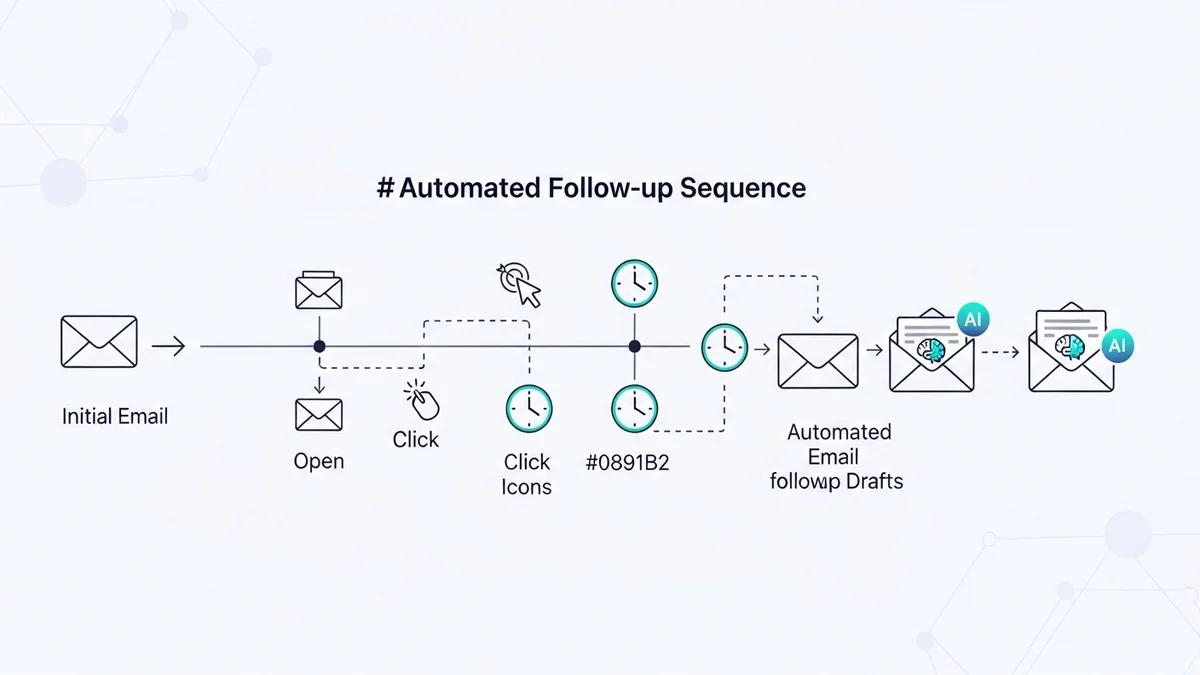
Most replies don't come from the first email. They come from follow-ups — which means your sequence strategy matters as much as your opener. The key is spacing and value, not repetition.
Optimal Follow-Up Timing
Benchmark data from Instantly's 2026 report points to 3–4 day gaps between follow-ups as the sweet spot. Too short feels harassing. Too long loses the thread of the conversation. Three to four days gives prospects time to act without letting your email get buried.
What Each Follow-Up Should Do
A common mistake is sending follow-ups that are just nudges: "Just bumping this up." Each follow-up should add a new piece of value or a new angle — a relevant case study, a data point about their industry, a question that reframes the original pitch. This gives the prospect a new reason to respond rather than just a reminder that you exist.
Tools like Instantly and Lemlist automate multi-step sequences while letting you customize each touchpoint. The automation handles timing; you handle substance.
Cold Email Performance Benchmarks: What "Good" Actually Looks Like
One of the most useful things you can do is calibrate your expectations against real numbers. Here's how performance breaks down across different list sizes and approaches.
| Approach | List Size | Average Reply Rate | Notes |
|---|---|---|---|
| Spray-and-pray (generic templates) | 1,000+ | 2.1% | High volume, low targeting, high spam risk |
| Targeted with basic personalization | 50 or fewer | 5.8% | Smaller lists, role-specific messaging |
| Intent-based with real personalization | 50–200 | 10.7%+ | Top-performer benchmark per Instantly 2026 data |
The pattern is clear: as targeting precision increases and list size decreases, reply rates climb sharply. The 100-email campaign that takes twice as long to build as a 1,000-email blast will consistently outperform it — not just in reply rate percentage, but often in absolute reply volume too.
The Role of AI Tools in Cold Email (Used Correctly)
AI writing tools have changed cold email workflows significantly — but they've also created a new failure mode. Buyers are now drowning in AI-generated spam, and they can identify it on contact. The generic "I noticed your company is growing" opener is dead precisely because AI made it ubiquitous.
The right way to use AI in cold email is for research and structure, not for generating the personalized details that make an email feel human. Tools like Jasper and Copy Ai can help you draft frameworks, test variations, and generate subject line options — but the specific hook that references a prospect's recent LinkedIn post still needs to come from actual research.
Where AI genuinely accelerates cold outreach:
- Drafting multiple subject line variations to A/B test
- Rewriting the same value proposition for different buyer personas
- Generating follow-up sequences with different angles
- Summarizing research about a prospect's company before writing
What AI cannot replace: the judgment about which signal to lead with, the authentic voice that makes an email feel like it came from a person, and the strategic decision about whether to send at all.
For teams managing high-volume outreach, Smartlead offers deliverability infrastructure alongside AI-assisted personalization — a combination that addresses both the technical and creative sides of the problem.
Deliverability: The Unsexy Factor That Determines Everything
You can have perfect copy, a well-researched list, and a compelling offer — and still get no replies if your emails don't reach the inbox. Deliverability is the foundation everything else sits on.
Domain Warming Is Ongoing, Not One-Time
Most senders warm a new domain for two weeks and consider it done. That's not how email reputation works. Inbox providers continuously evaluate sender behavior. A spike in bounce rate, a drop in engagement, or a surge in spam complaints can damage a warmed domain quickly. Reputation management is ongoing.
List Hygiene Isn't Optional
With 40%+ invalid emails showing up in purchased lists, validating your list before sending is non-negotiable. Every bounce harms your sender score. Every spam complaint is a strike against your domain. Clean your list before the first send, not after you notice your open rates collapsing.
Plain Text Outperforms HTML for Cold Outreach
HTML-formatted emails with images, buttons, and tracked links look like marketing. Plain text looks like a person. For cold outreach specifically — where you're trying to start a conversation, not broadcast a campaign — plain text consistently outperforms HTML on both deliverability and reply rate.
Building a Repeatable Cold Email System
The difference between a one-off campaign and a consistent lead generation channel is process. Top-performing teams treat cold email like a system with defined inputs (list quality, research depth, copy testing) and measured outputs (reply rate, meeting booked rate, pipeline generated).
Start with a tight ICP (ideal customer profile) based on intent signals rather than demographics. Build a list of 50–100 contacts who fit that profile and are showing active buying signals. Write personalized emails with a single clear CTA. Run a three to five-touch sequence with 3–4 day gaps. Measure reply rate and iterate on copy. Then scale the approach that works.
The goal, as the data consistently shows, isn't to send 10,000 emails hoping 200 respond. It's to send 100 emails and get 15–20 replies. Quality over quantity isn't a platitude — it's the math that makes cold email worth doing.
For teams managing the full outreach stack — from list building to follow-up automation — Instantly handles deliverability, warmup, and sequence automation in a single platform, which removes most of the technical friction that kills campaigns before they get started.
Cold email works in 2026. But "works" now means relevance, intent, and genuine personalization — not volume, tricks, or templates. Get those fundamentals right and the channel delivers on its reputation.