
The Real Cost of Email Overload in 2026
Here is a number that should alarm every knowledge worker: the average professional spends 4.1 hours per day managing email. In a standard 40-hour work week, that represents more than half of your productive time lost to reading, sorting, drafting, and deleting messages that rarely move the needle on your most important work.
By 2026, the volume of digital communication has not just increased — it has compounded in complexity. We are no longer simply "organizing" email; we are attempting to collaborate within a deluge of notifications, tasks, and external requests that span time zones, tools, and teams. The inbox has become one of the most expensive pieces of software in your stack, not because of what you pay for it, but because of the time it silently consumes.
The good news is that the tools designed to reclaim that time have never been more capable. The rise of Large Language Models and agentic workflows has transformed the inbox from a passive repository into an active, intelligent workspace. This guide breaks down what to look for, how the market is actually structured, and which tools are worth the investment for your specific situation.
What Makes an Email Productivity App Worth Your Money
Before evaluating specific tools, it is worth getting clear on what "email productivity" actually means. The market has splintered into very different product categories, and buying the wrong type is the most common mistake teams make. A rule-based filter is not an AI assistant. An AI assistant is not an email client. An email client is not a CRM. Understanding these distinctions will save you from paying for features you do not need while missing the one capability that would actually change how you work.
The Evaluation Criteria That Actually Matter
When we evaluate email productivity tools, these factors carry the most weight:
- Time-to-action reduction: How much does the tool compress the gap between receiving an email and taking meaningful action on it? This is the core metric. Everything else is secondary.
- Intelligence versus rules: Unlike traditional filters that operate on rigid if-then logic (move every email from Bob to folder A), AI-powered tools understand nuance, context, sentiment, and intent. The gap in real-world usefulness between rule-based and ML-driven tools is enormous in practice.
- Integration depth: A tool that sits awkwardly alongside your existing workflow adds friction. The best tools embed directly into Gmail or Outlook rather than demanding you migrate to a new client and learn new habits.
- Team versus individual scope: Solo users and teams have fundamentally different needs. Shared inboxes, delegation, and collaborative response templates matter enormously for teams and are complete noise for individual users.
- Automation ceiling: Can the tool trigger external workflows, update your CRM, or create tasks in your project management system? Or does its intelligence stop at the inbox edge?
The Question Big Tech Raises
There is a legitimate question hanging over every purchase decision in this category: with Google embedding Gemini into Gmail and Microsoft integrating Copilot into Outlook, is the third-party email productivity market defensible? The honest answer is yes — but only for tools with workflow depth. First-party AI features from Google and Microsoft are generalist, optimized for the median user. They are adequate for basic summarization and draft generation, but weak on workflow-specific intelligence. A tool that learns your individual inbox patterns over months builds a behavioral model that no generic LLM can replicate. Any tool whose entire value proposition is "write emails for you" faces direct competitive pressure from free built-in features. The tools worth buying in 2026 have moats beyond drafting convenience.
The 4 Categories of Email Productivity Apps
Mapping the market before you shop prevents category mistakes. Email productivity software falls into four distinct types, and the right one for you depends entirely on which problem you are actually trying to solve.
Category 1: AI-Powered Email Clients
These are full inbox replacements that bake AI drafting, prioritization, and triage directly into the reading experience. Superhuman is the canonical example: it charges $30 per user per month and earns it through speed — keyboard-first navigation, AI-generated reply suggestions trained against your communication style, and an inbox-zero philosophy enforced through design decisions rather than willpower. Spark Mail takes a more accessible approach, offering a free tier alongside its premium plan at $9.99 per user per month, with smart inbox sorting and AI reply assistance included. It is the better default for small teams that want intelligent email without the Superhuman price commitment.
Category 2: AI Overlays and Plugins
Rather than replacing your email client, these tools layer intelligence on top of your existing inbox. The advantage is zero migration friction. The limitation is that they are inherently constrained by what the host application exposes. This category includes tools like Gmelius, which transforms Gmail into a collaborative workspace with shared inboxes, automation sequences, and AI-generated responses — without requiring your team to abandon a familiar interface.
Newsletter
Get the latest SaaS reviews in your inbox
By subscribing, you agree to receive email updates. Unsubscribe any time. Privacy policy.
Category 3: Email Filtering and Triage Services
SaneBox is the clearest example in this category. It does not touch your email client at all — it works at the server level, analyzing your historical behavior to route emails into folders like SaneLater (low priority), SaneBlackHole (permanent unsubscribes), and SaneNews (newsletters). At $7 per month on its entry plan, it is the lowest-friction, highest-ROI starting point for professionals drowning in low-signal email. It also works with any IMAP or Exchange account, making it the most email-client-agnostic option in the entire market.
Category 4: Email Marketing and Outreach Automation
This category serves a different buyer: teams sending email at scale rather than managing inbound. Mailchimp owns the low end of this market with a genuinely usable free tier (up to 500 contacts and 1,000 emails per month) and predictive segmentation in its paid tiers. ActiveCampaign dominates the mid-market with CRM-integrated automation starting at $15 per month. For sales teams running cold outreach sequences, Instantly and Lemlist have built strong positions, while Smartlead handles high-volume campaigns with deliverability tooling that matters at scale. For AI-assisted content creation within outreach workflows, Copy.ai and Jasper are worth evaluating as drafting companions.
Top Email Productivity Apps Compared
The comparison below focuses on the productivity-layer tools most relevant to individuals and small teams managing inbound email. Pure marketing automation platforms are a separate buying decision with separate criteria.
| Tool | Starting Price | Best For | Core AI Features | Email Client Support | Team Capabilities |
|---|---|---|---|---|---|
| Superhuman | $30/mo per user | Power users, executives | AI reply drafts, priority inbox, snippets | Gmail, Outlook | Limited |
| Spark Mail | Free / $9.99/mo per user | Small teams, cross-platform | Smart inbox sorting, AI replies, priority scoring | Gmail, Outlook, iCloud | Strong |
| SaneBox | $7/mo (annual billing) | Individuals overwhelmed by volume | Behavioral filtering, priority learning | Any IMAP or Exchange | None |
| Gmelius | $15/mo per user | Gmail-based teams | AI drafts, automation sequences, shared inbox | Gmail only | Strong |
| Shortwave | Free / $9/mo per user | Gmail users wanting AI thread summaries | Thread summaries, AI drafts, smart search | Gmail only | Moderate |
Our Top Picks by Use Case
The honest answer to "which tool should I buy" is always: it depends on which constraint is costing you the most time. Here is how we break it down by actual use case rather than feature matrix.
If Your Core Problem Is Too Much Inbound Volume
Start with SaneBox before you do anything else. At $7 per month, it is the cheapest meaningful intervention in the market, and because it operates at the server level, it does not care what email client you use today or switch to next year. The SaneLater folder alone eliminates the anxiety of newsletters and CC'd threads burying your actual priority mail. Most users report a noticeable reduction in inbox noise within the first 48 hours — a response time that is genuinely rare for any productivity software category.
The limitation is that SaneBox handles triage but not composition. It will not help you write better or faster responses. Once your signal-to-noise ratio is under control, you can layer in a drafting tool on top. But triage first — the opposite order creates a leaky bucket.
If You Are a Power User Who Lives in Email
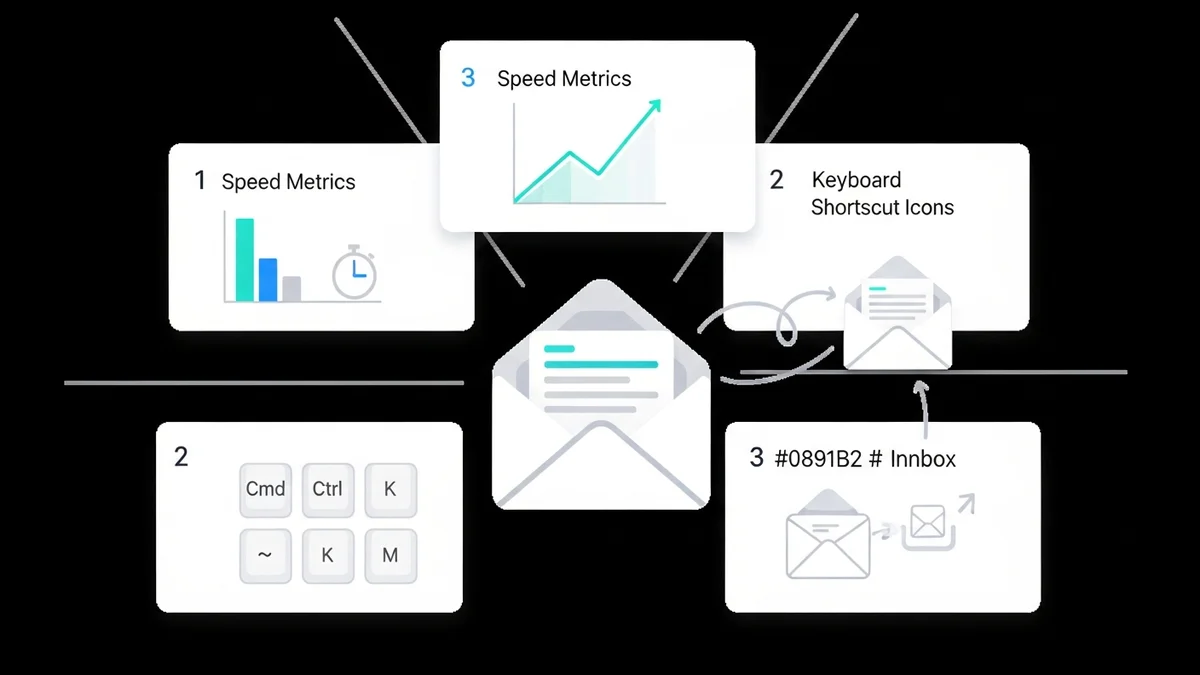
Superhuman is genuinely worth $30 per month if email is a primary communication channel for your role. The speed gains from keyboard-first navigation compound over time in ways that are difficult to appreciate until you have used it for two weeks. Its AI-generated reply suggestions are also context-aware in a way generic tools are not — they factor in thread history and your communication patterns rather than just the most recent message.
The honest caveat: Superhuman's Outlook support has historically lagged its Gmail experience. If your organization is Microsoft-first, Spark Mail at $9.99 per month per user is a more pragmatic choice and handles cross-platform mailboxes more gracefully.
If You Are Running Email at Scale for Marketing
For relationship-based marketing to an existing audience, Mailchimp remains the default starting point. The free tier is genuinely usable at up to 500 contacts, and predictive segmentation in paid tiers delivers real ROI lift. For deeper behavioral automation and CRM integration, ActiveCampaign at $15 per month earns the upgrade — particularly for teams that want triggered workflows based on subscriber behavior rather than just scheduled sends.
If You Manage a Shared Team Inbox
Gmelius is the strongest option for Gmail-based teams that need shared inbox management, internal email notes, and automated routing without abandoning their current client. If your team spans Gmail and Outlook, Spark Mail handles cross-platform shared inboxes more gracefully than any other tool at its price point.
How to Choose: A Practical Decision Framework
If you are still uncertain after working through the categories above, run through this checklist before committing to any free trial.
Step 1: Name Your Constraint
Is your biggest email problem volume (too many emails arriving and burying what matters), composition (takes too long to draft good responses), organization (cannot find things or track open threads), or collaboration (your team cannot coordinate through a shared inbox effectively)? Each constraint maps directly to a different product category, and buying across the wrong axis wastes both money and onboarding time.
Step 2: Audit Your Client Lock-In
Are you on Gmail, Outlook, or another provider? Several of the highest-quality tools in the market are Gmail-only — Superhuman, Gmelius, and Shortwave all fall into this group. If your organization is Outlook-first, your shortlist narrows quickly. SaneBox and Spark Mail are the most email-client-agnostic options available.
Step 3: Run the Time-Cost Math
At 4.1 hours of email time per day, a $30 per month tool that recovers even 30 minutes per day pays for itself within the first week for anyone billing above $20 per hour. The math on email productivity tools is unusually favorable compared to most software categories — the real bottleneck is evaluation and behavior-change during onboarding, not the subscription fee. The cost of not solving this problem compounds every single workday.
Step 4: Solve Triage Before Drafting
The most common buying mistake in this category is purchasing a drafting AI when the actual problem is inbox triage. If your prioritization is broken — if important emails are getting lost in the noise — no amount of faster composition will fix it. You will just write faster replies to the wrong things. Fix filtering and prioritization first. Layer in drafting assistance once your signal-to-noise ratio is genuinely under control. Then, and only then, does the speed of composition become the binding constraint worth spending money on.
The email productivity market in 2026 is mature enough that the tools which have survived are genuinely good at what they claim to do. The question is no longer whether to invest — the 4.1-hour-per-day statistic makes the math obvious. The question is which specific constraint to solve first, and whether your chosen tool's intelligence goes deep enough to stay valuable as Google and Microsoft continue building generalist AI features into their own platforms for free.