
The State of Email Open Rates in 2026: Why AI Is No Longer Optional
Email is not dying. It is, in fact, growing at a pace that should make every marketer pay attention. There are currently 4.55 billion email users worldwide, a number projected to hit 4.97 billion by 2028. At the same time, 347 billion emails are sent and received every single day — a figure on track to surpass 408 billion by 2027. The inbox is more crowded than ever, and the average open rate across industries sits at just 21.5%.
That 21.5% benchmark tells a sobering story: nearly 80% of emails go unread. If you are not actively applying AI to your email strategy in 2026, you are not just falling behind — you are working against yourself. The good news is that AI-powered tools have fundamentally changed what is achievable, both in production efficiency and in engagement performance. Teams that have rebuilt their email workflows around AI are seeing results that legacy approaches simply cannot match.
This guide covers the best AI email practices for improving open rates, the tools that make them executable, and the data-backed benchmarks you should be aiming for.
Why the 21.5% Open Rate Benchmark Is Both a Floor and a Ceiling
The 21.5% average open rate figure from Campaign Monitor is useful as a sanity check, but treating it as a target is a mistake. It is a cross-industry composite, which means it blends industries with inherently high engagement — like government and nonprofits — against sectors like retail and media that frequently underperform. Your real benchmark is your own historical data, segmented by audience type.
What the statistic does tell you, clearly, is that more than three-quarters of your subscribers are ignoring your emails on any given send. And with 87% of businesses already applying AI to email marketing workflows, the competitive pressure to stand out is accelerating. The irony is that only 6% of those organizations qualify as AI high performers. Adoption is widespread; genuine capability is rare. That gap is your opportunity.
What "AI High Performer" Actually Means in Email Marketing
An AI high performer is not a team that uses ChatGPT to write subject lines once in a while. It is a team that has rebuilt the entire email production and optimization loop around AI — from brief to send, including segmentation, personalization, timing, testing, and iteration. McKinsey data shows that only 1% of organizations consider themselves mature in enterprise-wide AI adoption. The ceiling for most teams is not tool availability; it is workflow architecture.
Best AI Practices for Subject Lines That Actually Get Opened
The subject line is the single highest-leverage element in any email you send. It determines whether the other 95% of your effort gets seen at all. AI brings three distinct advantages here that manual copywriting cannot consistently replicate at scale: pattern recognition, multivariate testing at speed, and predictive personalization.
Use AI to Generate and Test at Volume
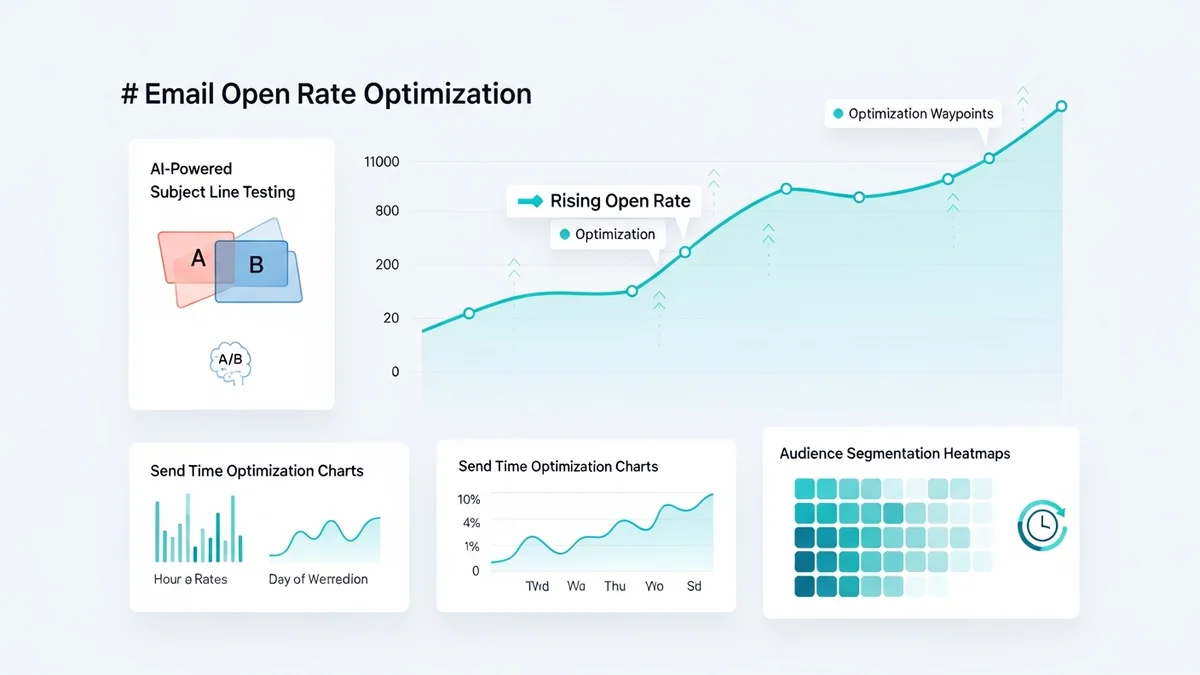
The best subject lines rarely come from the first draft. AI tools like Jasper and Copy Ai allow teams to generate dozens of subject line variants in minutes, each optimized for different angles — curiosity, urgency, social proof, or specificity. The practice that actually moves open rates is not picking the best one by gut feel; it is deploying multiple variants into a structured A/B test and letting performance data make the call.
Subject lines under 50 characters consistently outperform longer ones on mobile, and with 55% of all email opens now happening on mobile devices, character count is not a style preference — it is a functional requirement. AI writing tools can be configured to enforce this constraint automatically, removing the manual review step entirely.
Personalization Beyond "Hey [First Name]"
First-name personalization in subject lines is table stakes and increasingly ineffective as a differentiator. AI-powered personalization at the subject line level means pulling in behavioral signals: what the subscriber has clicked previously, what category they have browsed, what stage they are at in the customer lifecycle. Tools like ActiveCampaign use predictive models to surface the right content angle for each segment, which is a fundamentally different capability than dynamic field insertion.
Newsletter
Get the latest SaaS reviews in your inbox
By subscribing, you agree to receive email updates. Unsubscribe any time. Privacy policy.
The practical implication: if your personalization strategy still relies on merge tags and list segments built in a spreadsheet, you are leaving a measurable gap in your open rates.
Segmentation, Timing, and Mobile Optimization: The Three Pillars AI Executes Better
Relevance beats frequency every time. That principle is well understood in theory; AI makes it actionable in practice. The three areas where AI most directly improves open rates are segmentation precision, send-time optimization, and mobile rendering — each of which benefits from algorithmic decision-making over manual judgment.
Intelligent Segmentation
The average CTR across industries is 2.3%, and a low CTR is a diagnostic signal as much as a vanity metric. It typically indicates either the wrong message reaching the right audience, or the right message reaching the wrong one. AI-powered segmentation engines analyze engagement history, purchase behavior, and even inactivity patterns to build dynamic audience clusters that update automatically as subscriber behavior changes.
Platforms like Smartlead and Instantly are built for cold outreach with strong AI segmentation layers, making them particularly effective for sales-focused teams where list quality and send relevance directly determine deliverability and open rates. For lifecycle-focused marketing, ActiveCampaign brings predictive segmentation into a full automation context.
Send-Time Optimization
Sending at the "best time" used to mean picking Tuesday at 10am based on industry blog posts. AI-powered send-time optimization means analyzing each individual subscriber's past open behavior and scheduling sends to arrive at the moment they are most likely to engage. This is not a marginal lift — for disengaged segments, it can mean the difference between a 10% and a 20% open rate on the same email.
Mobile-First Design as a Non-Negotiable
With 55% of email opens happening on mobile, this is not a trend to plan for — it is a present-tense reality. Subject lines that truncate past 40-50 characters on a phone screen, preheader text that does not load, CTAs too small to tap without zooming — any of these failures happen before the reader even processes your message. AI-assisted email builders can now flag mobile rendering issues automatically before send, a workflow step that previously required manual QA across multiple devices.
Benchmark Data: What Good Open Rates Actually Look Like by Use Case
The 21.5% industry average is a starting point, not a goal. The following table maps realistic open rate benchmarks to email type and audience relationship, using data from Campaign Monitor and Litmus research:
| Email Type | Audience Relationship | Realistic Open Rate Target | Primary Open Rate Lever |
|---|---|---|---|
| Welcome / Onboarding | New subscribers | 45–60% | Timing (send immediately after signup) |
| Newsletter | Engaged list | 25–35% | Subject line + send-time optimization |
| Promotional / Campaign | Mixed list | 18–25% | Segmentation + personalization |
| Cold Outreach (B2B) | Prospecting | 30–50% | List quality + deliverability |
| Re-engagement | Lapsed subscribers | 10–18% | Offer specificity + subject curiosity gap |
| Transactional | Customers post-purchase | 60–80% | Relevance (already expected by recipient) |
The takeaway from this table is that open rates are not a single number to optimize — they are a family of metrics that respond to different inputs depending on context. An AI strategy that treats all email types identically is no strategy at all.
Which AI Email Tools Are Best for Open Rate Improvement
Not every AI email tool attacks the open rate problem from the same angle. The right choice depends on whether your challenge is primarily a copywriting problem, a deliverability problem, a segmentation problem, or a workflow velocity problem. Here is an honest breakdown of where different tools in the market excel:
For Cold Outreach Open Rates: Smartlead and Instantly
Smartlead is built for teams doing high-volume cold email where deliverability and inbox placement are the primary open rate driver. It manages mailbox warming, rotation, and sending infrastructure in a way that manually managed accounts simply cannot replicate at scale. Instantly takes a similar approach with a slightly more accessible onboarding for smaller teams, and its AI personalization layer helps generate opening lines that reference prospect-specific signals — one of the most reliable open rate lifts in cold outreach.
For Newsletter and Marketing Email: Mailchimp and ActiveCampaign
Mailchimp has invested heavily in predictive analytics and AI-generated subject line recommendations, making it a strong default for teams building opt-in lists. Its send-time optimization feature is genuinely effective for newsletters with consistent weekly or biweekly cadences. For more complex lifecycle automation with richer segmentation, ActiveCampaign offers predictive sending and lead scoring that feeds back into open rate performance over time.
For AI-Assisted Copywriting: Jasper and Copy.ai
If your open rate problem is a subject line problem — which it often is — Jasper and Copy Ai are the most direct solutions. Both tools can generate subject lines tuned to emotional triggers, character limits, and brand voice. Neither replaces a testing discipline, but they dramatically accelerate the generation of variants worth testing in the first place.
For Personal Inbox Management and Response Rates: Superhuman
If your open rate challenge is on the receiving side — knowing which emails to prioritize and respond to — Superhuman takes a different angle entirely. It uses AI to triage and surface high-priority messages, which is relevant for sales teams where response rate is the functional equivalent of an open rate metric in a two-way communication context.
The ROI Argument for Getting AI Email Practices Right
Email marketing delivers an ROI benchmark that no other marketing channel consistently matches. According to the State of Email Report 2025, 35% of marketing leaders see $10–$36 returned for every $1 spent on email, 30% see $36–$50 in return, and 5% see more than $50 back. The "~40:1" benchmark is real and within reach for most teams — but only when email is executed with precision rather than volume.
The teams capturing that ROI are the same teams that have moved past the two-week email production cycle that plagued 62% of marketing teams in 2023. By 2025, only 6% still operate on that timeline. Enterprises using AI-powered platforms are achieving 70% faster production timelines, with outliers like Amazon reducing email build time by 95%. The connection between production efficiency and open rate performance is not coincidental: faster iteration cycles mean more tests, more learning, and faster convergence on what actually works for your specific audience.
The 408 billion daily emails projected for 2027 represent the noisiest inbox environment in history. The teams that will sustain open rates above the 21.5% average are not the ones sending more — they are the ones sending smarter, with AI embedded at every step from segmentation to subject line to send time. The tools are available. The gap between adoption and performance is a workflow problem, not a technology problem. Close the gap.